



Given our ongoing concern about the health and sustainability of the planet and how climate change will impact future generations, it’s no wonder that cryptocurrencies have come under the same scrutiny as other “dirty” industries such as coal and oil.
How much energy do cryptocurrencies consume?
Looking at the two largest cryptocurrencies, Bitcoin and Ethereum, we gained some insights.
Bitcoin currently consumes an estimated 150 terawatt-hours of electricity annually – more than the energy usage of the entire country of Argentina, which has a population of 45 million people.
Prior to 15 September 2022, Ethereum used an estimated 78 terawatt-hours of electricity each year, comparable to the power consumption of Chile (population 19 million people).
However, on 15 September 2022, Ethereum implemented a major network upgrade that completely changes how the blockchain verifies transactions. Called proof-of-stake, this system has reduced Ethereum’s energy consumption by more than 99%.
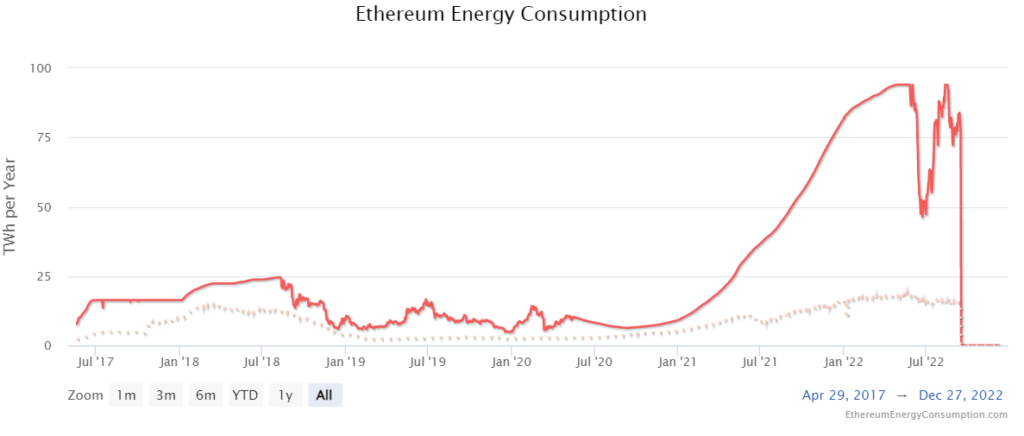
What’s the effect of this move by Ethereum?
As a result of this proof-of-stake change, there is no longer a network of energy-intensive mining devices competing with each other in order to create the next block for the underlying blockchain.
Overall, the move by Ethereum towards a more energy efficient model is welcome news and will hopefully lead to other cryptocurrencies following suit.
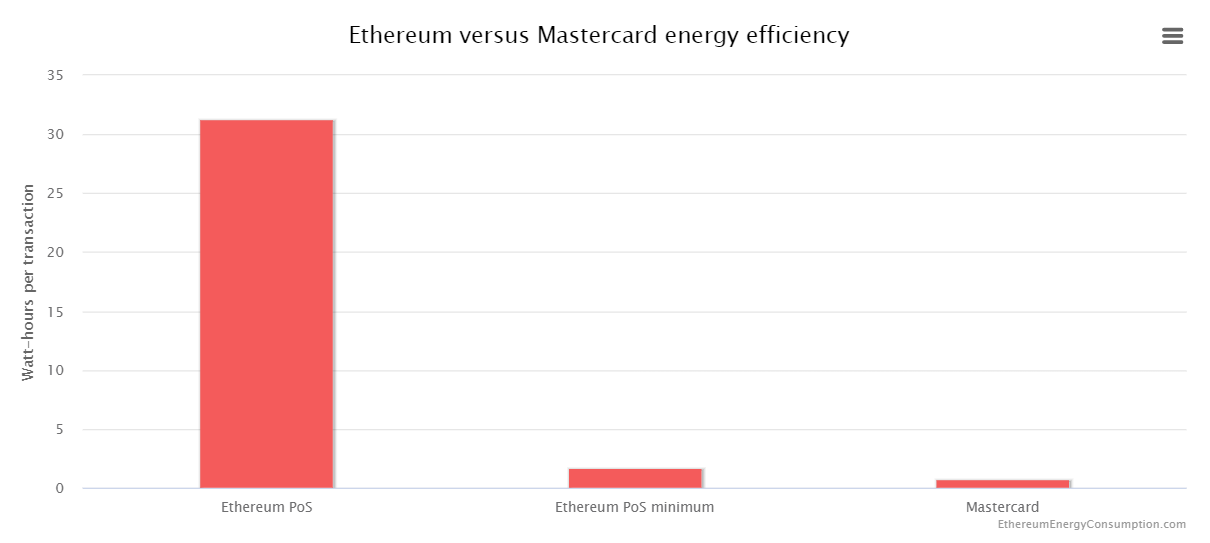
However, despite this change by Ethereum presenting a significant improvement with regard to the network’s electricity consumption, it is worth noting that blockchain technology in general is not energy-efficient compared to more centralised alternatives such as Mastercard.
The chart below shows the energy efficiency of Ethereum (pre- and post-PoS) versus Mastercard’s efficiency:
So, are cryptocurrencies more desirable as investment assets now?
Bear in mind that cryptocurrencies are still speculative assets with extremely volatile price movements. As such, treat them with caution when it comes to deciding whether or not to include them in your investment portfolios.
At Netto Invest, we continue to advocate the fundamental investment principle of owning a well-diversified investment portfolio that is split between a variety of asset classes, as well as a diversified blend of asset managers with long-term track records.

By Jonathan Botha, CFP®
B.Com
