



Gross Domestic Product (GDP) is the measure of a country’s economic output and is widely used as an indicator of the overall health of an economy. If such a correlation existed, it would make sense to invest in countries with high GDP growth rates (like India and China) and avoid countries that have low GDP growth rates (like South Africa where our electricity crisis continues to have a crippling impact on our GDP growth).
So, is there a link? Study #1
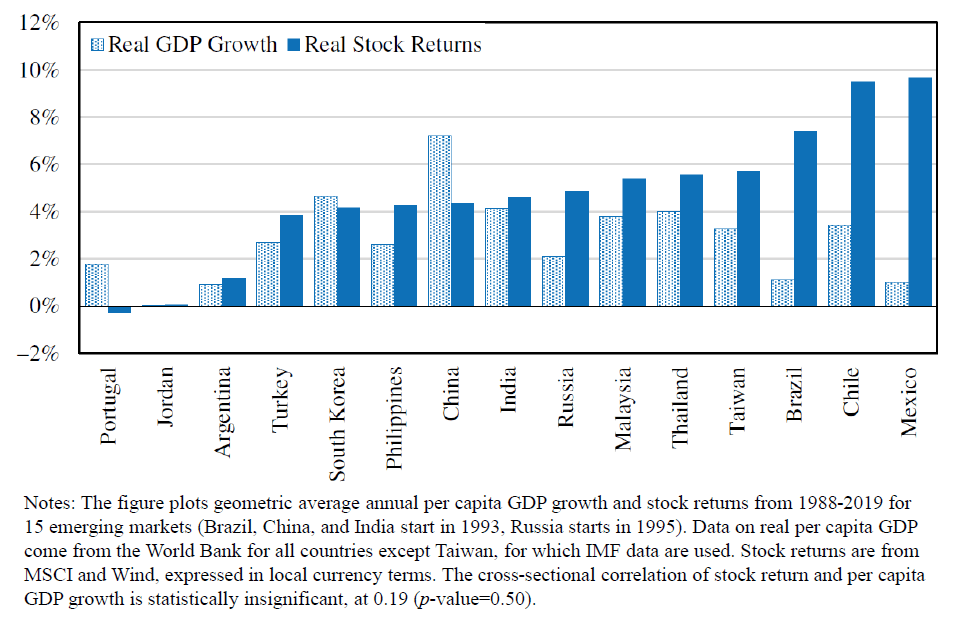
A 2022 study of 15 emerging and 21 developed equity markets ranging from 32 years to 120 years were analysed to determine if GDP growth was a predictor of equity returns.
The authors found that there was no reliable link between per capita GDP growth and stock returns in developed markets. The graph for developed markets illustrates that for the period 1900 to 2019, South Africa had the highest real stock market returns but the lowest real GDP growth.

Seriously, there’s really no link? Study #2
In 2014 the authors of a different study, The Growth Puzzle, not only found that past economic growth did not predict future equity returns but also that contemporaneous economic growth was not correlated with current stock market performance.
So even if one knows that the GDP growth of China will be higher than that of South Korea in 2023, there is no assurance that the 2023 stock market return for China will be higher than that for South Korea.
However, they did find that stock returns this year predict economic growth next year – in the short run, high returns this year are associated with higher-than-average economic growth in the near future. That should not come as a surprise as the stock market is forward-looking.
How then do you make solid investment decisions over time?
In the face of a lack of relationship between GDP growth and stock market returns, investors should focus on diversifying their portfolios across different asset classes and sectors as this is more effective than trying to time the market based on short-term economic indicators such as GDP growth.
By adopting a long-term investment strategy and focusing on fundamentals like earnings growth and valuation, investors can build a portfolio that is better positioned to weather the ups and downs of the economic cycle.
Speak to your CERTIFIED FINANCIAL PLANNER® professional about appropriate ways to diversify your investment portfolio to increase the likelihood of achieving your long-term goals.

By Morné Bezuidenhout, CFP®
B.Com LLB
