



Growth investing is a strategy of investing in companies that are expected to experience significant growth in revenue, earnings and cashflow. We all need to include growth stocks in our portfolios to avoid our returns being outpaced by inflation over time.
At the same time, growth assets come with a side-serving of additional risk. And history proves that the financial markets are far from immune to the risks of global events.
Diversification – the only ‘free lunch’ in investing?
The investors who weathered the financial storms of the past most successfully shared one attribute: they opted for broad, purposeful diversification.
Diversification is a practical blueprint for protecting your personal balance sheet while still compounding wealth. A well-diversified investment strategy increases the probability of meeting your long-term financial objectives even if it occasionally lags the market’s hottest theme for a while.
Let’s unpack why it works, where the trade-offs lie and how to apply it.
Why diversification works:
When emotion rules, investors tend to buy into the same “can’t-lose” shares and sectors. However, history shows how costly this fear (or greed) response can be:
- High-growth US shares were crushed in 1973-74.
- Global equities unravelled on Black Monday 1987.
- Dot-com exuberance imploded in 2000-02.
- Highly-leveraged banks toppled in 2008-09.
- Pandemic-hit travel and energy counters plunged in 2020.
On the other hand, portfolios that blended assets propelled by a variety of forces – such as South African gold mining, government bonds, offshore balanced assets and defensive consumer staples – lost less and recovered faster in those decimating times.
The principle is that by spreading investment exposure, you blunt the effect of any single shock and also give your capital several paths to grow again once conditions normalise.
The Four Pillars of Effective Diversification:
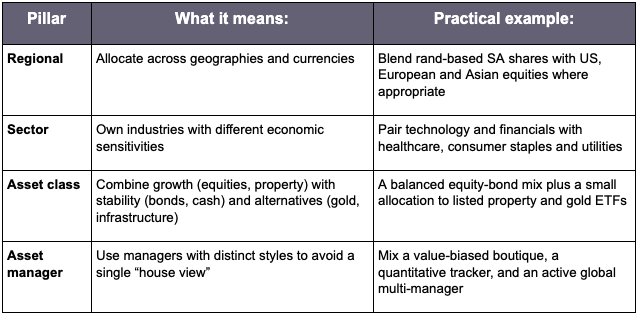
In a well-diversified portfolio, diversification layers hedge against each other: regional differences help when the rand weakens; sector balancing cushions company-specific shocks; uncorrelated asset classes smooth out returns; and manager variety reduces the risk of any single decision-maker underperforming.
What’s the trade-off? Risk vs. Return Principle.
A diversified portfolio can feel frustrating because it will rarely top the leader-board in any isolated year. By definition, something you own is always “underperforming” the best-performer of the moment. This is the price we pay for portfolio resilience. However, the aim is not to win every sprint, but to finish the marathon with your purchasing power intact and your lifestyle goals funded.
When assessing risk and return, consider:
- Time horizon: The longer your horizon, the more growth assets you can hold knowing that interim volatility is tolerable.
- Capacity for loss: Map your draw-down tolerance realistically, both financially and emotionally.
- Required return: Work backwards from your objectives (e.g., inflation + 4%) to the blend of assets most likely to deliver that outcome with acceptable variability.
- Correlation: Look beyond individual asset risk to how components move together. Low- or negative-correlation pairs reduce portfolio risk more than merely adding “safe” assets.
Keeping growth on the table.
Diversification does not mean hugging cash forever. A globally-balanced portfolio still holds substantial exposure to growth engines – innovative companies, emerging-market consumers, infrastructure, renewable energy and property.
The difference is that those growth assets are not all located in one country, one currency or one sector. History shows that this approach captures the bulk of the upside and avoids the crippling drawdowns that derail long-term compounding.
How to achieve diversification: A Practical Perspective
- Clarify your objectives. Begin by detailing spending requirements, legacy intentions and the real return you need to achieve them.
- Build a globally diversified core. Establish a multi-asset foundation of equities, bonds, property and alternatives, allocated across several regions.
- Layer complementary strategies. Introduce managers with distinct styles (value, quality, momentum) and incorporate low-cost index trackers to broaden your return drivers.
- Monitor, rebalance and tune out the “noise”. Gauge progress against your objectives not the news headlines and rebalance when allocations drift. Diversification may seem superfluous during calm markets, but it becomes indispensable when volatility strikes.
The bottom line:
Market storms are inevitable; permanent capital loss is not. By diversifying thoughtfully across regions, sectors, asset classes and managers, and by judging risk and return through the lens of long-term goals, you protect your balance sheet and give your wealth multiple avenues to grow. That may mean sacrificing the occasional short-term bragging right, but it dramatically raises the odds of arriving at your destination financially independent and future-proofed.
Over the years, Netto Invest clients have tuned out the noise and benefitted by achieving their investment goals – guided by the straightforward principle of blending assets whose returns come from diverse sources.

By Michael Maré, CFP® FPSA®
B.Com
