



Investing offshore is an essential strategy for South Africans if you are seeking to diversify your investment portfolio and mitigate local economic risks.
The landscape of offshore investments from South Africa has evolved significantly, influenced by factors such as asset swaps versus direct offshore investments, rapid exchange rate fluctuations, allowances such as the annual Single Discretionary (SDA) and Foreign Investment (FIA) allowances, performance in rand, and the South African economy’s position in the global context.
Asset swap vs. direct offshore investment.
South African’s have two avenues for offshore exposure: asset swaps and direct offshore investments. Let’s take a look at each:
Asset swap explained
An asset swap involves using a local asset manager’s offshore allowance to invest in foreign assets, while keeping your investment in rand. It’s quick, requires no SARS approval, and it’s easy to measure the investment performance in rand as well as comply with your SARS tax obligations. Using an asset swap does not make use of your SDA or FIA. Tax reporting is all based on your rand returns.
Direct offshore investment explained
A direct offshore investment (hard currency) requires you to externalise funds. This may require SARB/SARS approval depending on your circumstances.
For example: each South African resident is allowed to transfer up to R1 million per calendar year under the SDA without prior tax clearance. The SDA includes transactions such as importing products or spending from your SA bank accounts whilst travelling abroad, so calculate carefully; you do not want to breach the allowance threshold.
An additional R10 million can be transferred annually under the FIA upon application to SARB and with SARS’ approval.
Tax reporting with respect to direct offshore investments is based on the “hard currency” and an exchange rate provided by SARS.
The Rand/Dollar Exchange Rate as a factor.
The ZAR/USD exchange rate is a factor in evaluating offshore investing with the rand depreciating by close to 6% pa, since December 2004 to April 2025.
The rand is in the Top 20 most-traded currencies in the world and can be quite volatile experiencing periods of rapid weakness and strength against the US dollar. These rapid movements can be worrying when deciding whether to send your savings offshore or not.
An example of extreme market timing:
When investing offshore there are two factors which influence your investment returns: your rand/dollar exchange rate price point and the price point of the offshore asset you choose to invest your funds in. Using the MSCI World Index for the offshore returns we looked at three rapid negative rand movements relative to the US dollar over the last two decades and simulated the return if you invested your rand at the worst price (the Peak) or the best price over the period before or after the Peak decline as illustrated in Figure 1 below:
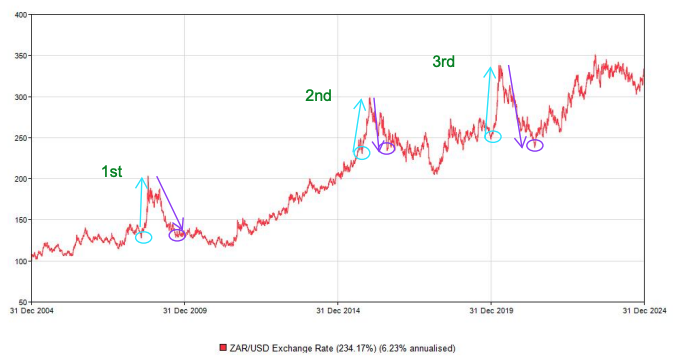
Source: ProfileData
First Peak
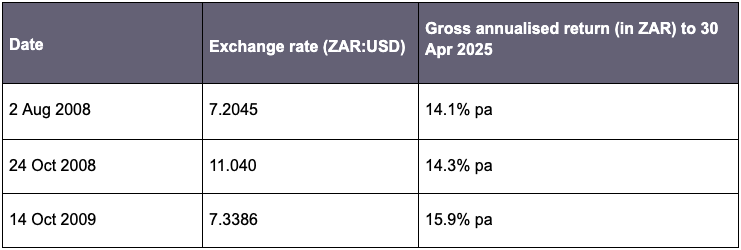
If you invested your rand at the peak when it was almost 60% weaker than two months prior, you would have an annualised ZAR return of 14.3% compared to 14.1% before or 15.9% after if you perfectly timed the same rand price before or after the peak weakening.
Second Peak
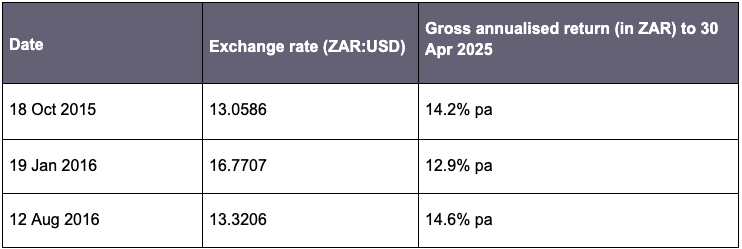
If you invested your rand at the peak when it was almost 30% weaker than three months prior, you would have an annualised ZAR return of 12.9% compared to 14.2% before or 14.6% after if you perfectly timed the same rand price before or after the peak weakening.
Third Peak
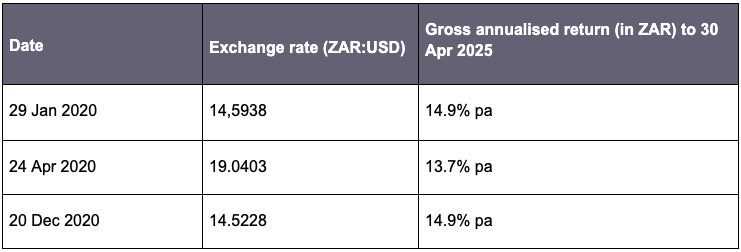
If you invested your rand at the peak when it was 30% weaker than three months prior, you would have an annualised ZAR return of 13.7% compared to 14.9% if you perfectly timed the same rand price before or after the peak weakening.
What are the most important factors for offshore investing?
The example above is extreme, but it illustrates the point that offshore market performance is likely a bigger factor than the rand/dollar exchange rate at the time of investing, and that time in the market appears to be the biggest influence overall.
In short, your decision to allocate capital offshore should be driven more by:
- The long-term requirement for an offshore allocation in your portfolio
- How long you intend to keep the funds offshore
- The fact that the South African stock exchange represents less than 1% of global GDP
And less by:
The current rand price relative to the US dollar at the time of deciding to invest offshore.
What to remember from all this offshore investment analysis?
- From 2004 to 2025, investing rand offshore has proven itself as an effective hedge against currency risk.
- South Africa’s shrinking role in the global economy makes international diversification key to maintaining your lifestyle.
- Whether via direct investment under the SDA or through asset swap arrangements, global allocations should play a role in almost any South African investment portfolio.
- The choice between asset swaps and direct offshore investments depends on your individual circumstances, including the need for tax clearance and your desired level of control over investment decisions.
- By understanding these factors and leveraging the opportunities available, you can benefit from offshore investments as a South African investor, achieving your financial goals and securing your wealth in an increasingly interconnected world.

By Ryan Winter, CFP®
B.Com
